Importance of Holi
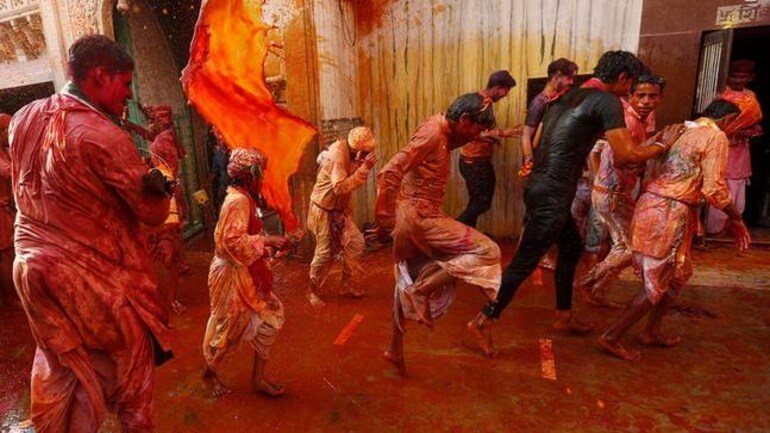
Image for representational purposes only. Photo: Reuters
From smearing each other with colours to enjoying a plate of delicious gujiyas together, the festival of Holi ushers in a carnivalesque mood among people of all age groups, every year.
While the main festival of colours is officially due in a couple of days, a lot of people in the country have already started indulging in merrymaking.
Most of us observe Holi every year, but do you know why we actually celebrate it?
An ancient Hindu festival, which later became popular among non-Hindu communities as well, Holi heralds the arrival of spring after winter. It signifies the victory of good over evil and is celebrated as a day of spreading happiness and love. The festival is also celebrated as thanksgiving for good harvest.
The legend
According to Bhagvata Purana, King Hiranyakashipu--the king of demonic Asuras, who could neither be killed by a man or an animal--grew arrogant and demanded that everybody should worship him as god.

Photo: Reuters
The king's son, Prahlada, disagreed and chose to remain devoted to Vishnu. Hiranyakashipu was infuriated and subjected his son to cruel punishments. Finally, Holika, the king's sister, tricked him into sitting on a pyre with her. While Holika protected herself with a cloak, Prahlada remained exposed. As the fire blazed, the cloak flew from Holika's body and encased Prahlada, thus saving his life.
Later, Vishnu appeared in the avatar of Narsimha, half man and half lion, and killed the king. This is why Holi begins with the Holika bonfire, which marks the end of evil.
According to another legend, Lord Krishna had developed a characteristic blue skin colour after Putana, a demon, poisoned him with her breast milk. Krishna worried if the fair-skinned Radha and her companions would ever like him because of his skin colour. Krishna's mother then asked him to approach Radha and smear her face with any colour he wanted. The playful colouring gradually evolved as a tradition and later, as a festival observed as Holi, in the Braj region of India.

Lathmar Holi. Photo: Reuters
The celebration
Holi celebrations start on the night before Holi with Holika Dahan, where people perform rituals in front of a bonfire, praying for their inner evil to be destroyed, just as Holika was killed in fire.
The carnival of colours begins the next morning, where people come out on the streets to play with colours, and drench each other in coloured water through water guns or balloons.
Interestingly, different regions in India observe varied customs on this day. In West Bengal and Assam, for instance, Holi is known as Basanta Utsav or spring festival.

Holi in Vrindavan. Photo: Reuters
A popular form of Holi, called Lathmar Holi is celebrated in Barsana, a town near Mathura, in Uttar Pradesh, where women beat up men with sticks, as those on the sidelines chant ''Sri Radhey'' or ''Sri Krishna.''
Again, in Maharashtra, it is the time of Matki Phod (breaking the pot). Men climb on top of each other to form a human pyramid up to the height from which a pot buttermilk is hung. The one who breaks the pot is named the Holi King of the year.
In Vrindavan, widows and estranged women immerse themselves in colours on Holi. Again, in Punjab, Sikhs revel in colours on Hola Mohalla, which is celebrated a day after Holi.
The customs and rituals may be different across regions but what unites them is the spirit of this festival of colours.
Importance Of Holi Festival
 The festival of colours – Holi is celebrated in the season of Vasant. It is the time when winter ends and summer commences. As a consequence of these seasonal changes, the intensity of disease spread increases significantly. In ancient times to save our human body from these dreadful diseases, a tradition of playing Holi with Palash Flower was followed. This sattvic fragrance provided sattvik nourishment to the neurons and the nervous system, in fact to the entire body. Whichever of the seven colours were deficient in the body, would be supplemented in this manner. Consequently, we would not become irritable or depressed even in circumstances that would have otherwise made us so. This is the benefit of Holi. Conversely inappropriate tradition of playing Holi with colours made up of chemicals is in practice today. Moreover people use abusive language, spill mud over each other which is both morally and ethically incorrect. We must not involve in any such bad practices. Instead we must make good use of natural colours which will benefit us in sustenance of good health. Every colour affects our mind and thoughts. There are seven colours as well as seven Dhatus in our body. Diseases usually occur as the consequences of some deficiency or excess in any of these seven Dhatus or colours. Those who treat diseases through use of different colours (Chromatherapists) know which diseases can be cured with which colourWater filled in a bottle of the deficient colour is kept in the sun and then given to the patient. With the supply of the deficient colour, patients are cured. . But wonderful indeed is Indian culture! Here we find the tradition of wetting people in the colours of Palash flowers in the name of Holi Celebration to make them capable of withstanding the scorching heat of the ensuing summers and also keep their seven colours in balance. Holi is played with Palash flowers in order to balance the seven Dhatus and increase the life force and also to resist diseases caused by seasonal changes. Thus, Holi is directly related with health. Unbounded use of chemical colours in the present days is causing severe health concerns and even Doctors concur to this fact. Chemicals, detergents and impure sand particles used in making artificial colours have harmful effects on not only human skins but also on eyes, throat and hair.
- Get link
- X
- Other Apps
Labels:
Important news by Bhartiyatyohar
- Get link
- X
- Other Apps
Comments
Post a Comment